It is the year 1889 A.D., an age of enlightened discovery, of unrivaled and often fantastic scientific and technological progress: powered by coal, steam and electricity. It is also an age of empires and empire building, of fierce and often complex competition for wealth and material resources by both governments, corporations and private individuals. The Nations of Europe, the Americas, Africa and Asia vie for power, prestige and prosperity on the world stage and across the solar system.
Welcome Lords, Ladies and Gentlemen.
Welcome Lords, Ladies and Gentlefolk.
This blog will be devoted to my literary and cosplay interests and stories set in my own alternative historical steampunk background. I hope people enjoy the stories, as much as I enjoy devising and writing them and that it stimulates their own artistic interests, entertains them or if nothing else fires their own imaginations.
A special note to new readers of this blog, the entries "Nation States" are gazetteers of the nations as they exist in the An Age of Steam, Steel and Iron background, each with a few remarks/observations about each nation as they exist within. Any post headed by the title containing the words "Story Snippet" or "Fragments" is a stand alone, snapshot of the background, they will be developed into fuller stories in future, but at present they serve to give the viewer/reader a measure of what this world is like, what is going on in it and who some of the players are. Full stories, will be headed by their title and a roman number, as they will generally be in several parts.
Comments, suggestions or remarks by readers are welcomed.
I would like to thank the following people:
Yaya Han, for getting me seriously interested in cosplay at a time when things were looking very glum for me back in 2006 with several extended stays in hospital due to illness, and motivating me to get actively involved.
Ashley Du aka UndeadDu, for her unfailing friendship and cheerful support since we first met in 2014 at the Hamilton Comic Con, and for being my Cosplay mentor and advisor.
Sara Marly, for her interest in and support for my writings, since we first met in 2016 at the Hamilton Comic Con and incidently helping me make up my mind to finally do this.
Stephen Thomson, my friend, for his advise and assistance with creating and setting up this blog.
Daniel Cote, my friend and co-worker for his advise and friendship over the years.
The People of the The Aegy's Gathering (particularly Jonathan Cresswell-Jones, Scott Washburn and Jenny Dolfen, all of whom I have kept in contact with over the years), who were brought together in friendship by a certain randomness of chance and a common interest in the Honor Harrington books and stayed together despite distance and the strains of life.
The People of the Wesworld Alternative History website, who gave me the opportunity to sharpen my writing and story telling skills while directing the affairs of Lithuania and briefly France during their 1930s timelines.
My parents Mary Ellen (1946 - 2019) and Logan, my siblings Adam and Danika and various friends both online and at work and play for putting up with me, encouraging and supporting me both in the very good times and the very bad times.
I remain as always yours very sincerely, your obedient servant, Matthew Baird aka Sir Leopold Stanley Worthing-Topper
Thursday, July 27, 2023
Fragments from the Americas (Part V)
President Hayes, thoughts were interrupted by the arrival of a military aide-de-camp, from General Schofield, he silently passed the president the promised précis of the Patrick memorandum. At a polite, nod from his president, the aide left the room and made sure that the president would not be disturbed for several minutes, till he had read and had time to digest at least the broad scope of the memorandum and it's implications. The précis ran to well over fifty pages, so lord knew what the actual memorandum was like, Hayes thought absently, as he began to dive into it's contents.
Hayes noted ruefully, that Major-General Logan Patrick, did not pull his punches with his assessments of the political and military situation in the Disputed Territories. They were blunt, hard nosed and aimed at achieving practical solutions especially those concerning overall strategies,increasing available manpower and allocations of logistical support as quickly as possible. The problem was, the very things he was advocating while they would probably solve most of the problems that were vexing both his administration and the US Army in the Disputed Territories, would cause Congress to go into convolutions! Which might not be a bad thing, Hayes thought, though his cabinet officers might disagree with him on that.
In the first part of the précis, General Patrick detailed each of the five departments in the Disputed Territories and the particular problems confronting them.
The Department of the North West, General John Pope commanding, covering the Territories of Idaho, Montana and Wyoming.
Covering some three territories, was the second largest of the five departments, and the problems facing General Pope were legion, he had to police this considerable area, establish permanent garrisons and pro-unionist administrations, providing, transport and distribute all sorts of goods and services. Pope had to pacify a collection of stubbornly independent enclave states within the region, deal with truculent ranchers, cattle rustlers and desperadoes forming virtual private armies roaming the region.
Countering and repelling the I.S.A. advance into Idaho and providing support to The increasingly isolated Department of the Pacific were two other vitally important tasks, that General Pope had also to consider and deal with. Further, raids and skirmishes with war parties of the Lakota Nation Indians or allied or just hostile Indian tribes were endemic to the area and also had to be continously dealt with. Further Pope was expected by Congress to energetically attack the Lakota Nation in co-ordination with the Department of the Dakotas and force it's submission. Pope had repeatedly stated to Congress and his military superiors that he had enough forces to deal with only one or two problems besetting his department at a time, not the dozen or so that he was routinely confronted with.
The Department of the Dakotas, General Henry Beebee Carrington commanding, covering the Territories of North and South Dakota.
Carrington despite being an abysmal and incompetent Indian Fighter, was a magnificant organizer, disciplinarian and drillmaster and had worked with success at keeping his department protected from repeated Indian raids across the Missouri River, from the Lakota Nation and keeping open a direct land route to the Department of the North West and providing it with much needed munitions and other essential supplies, via the heavily patrolled and fortified North Dakota panhandle. Patrick, felt that Carrington, had done as well as could be expected of him, in securing the two Dakota Territories, in the circumstances. His complete lack of success in penatrating and subduing the Lakota nation along the Missouri was due to a lack of overwhelming manpower and sustained logistics to do the task being made available to him by Congress. To balance this, Carrington has been vigorously successful in stamping out any tendency to independent Enclavism, within his department, although some in Congress have accused him of rather too vigorous or heavy handed methods of accomplishing this important part of his departmental mission. Regardless, General Carrington at least does not, unlike some of his fellow departmental commanders have to continously look over their shoulder for enemies behind their lines, while dealing with the enemies to his front.
The Department had fewer U.S. regular regiments assigned to it then perhaps any other, save perhaps the Department of the Mid West. The majority of the troops at Carrington's command were troops he had actively organized or raised himself from the two Dakotas territories: Territorial national guards, territorial militia and volunteers assisted by a small number of U.S. regular regiments or detachments and U.S. Volunteer regiments or battalions. Like Pope, Carrington had to safeguard and police various cities, towns and settlements, maintain and protect the transport of goods and services to those communities, by road, rail, air and water routes that were often contested by the Lakota. He and his troops had to repel or resist numerous raids, by Lakota war parties that had gotten over the Missouri. Meanwhile while attending to all this General Carrington was expected to assist the two territorial governors in their efforts to prepare North and South Dakota for their organization and admission into the Union as states, as well as safe-guard the preliminary elections for the two territories planned representatives and senators to the U.S. Congress.
The Department of the Mid West, General John Rutter Brooke, covering the States of Nebraska and Kansas.
Actually one of the quietest of the five departments, all things considered, due to both the states being largely loyal to the Union government. Although a large portion of Western Nebraska was and still is effectively Lakota Nation territory as well as a very small northwestern corner of Kansas. Outbreaks of independent enclavism amougst Nebraskans and Kansasians had been very minimal and easily dealt with by local pro-Union military force directly or through careful and effective civil-military negotiations early on in the Second Civil War. However a considerable portion of the western half of the state of Nebraska has fallen under the control of the Lakota Nation as well as a small corner of Northwestern Kansas, and Lakota war parties regular mad raids across the department, though in most cases, these raids have been regularly halted or driven back into Lakota held lands.
General Brooke's hard work, careful organization, concern for logistics and good working rapport with both military and civilian subordninates and especially his concern for building a good working relation with the various pro-unionist Indian tribal factions that had stayed loyal to the Union during the first civil war (and consequently had to flee the Indian Territory, now the Confederate State of Oklahoma) and been resettled in pro-unionist Kansas. They had been stalwarts in keeping Kansas in the Union ever since. General Brooke is unusual amoungst his five departmental peers as his military administration is both respected and appreciated by local, district and state authorities and the great majority of pro-unionist inhabitants whether long established residents, new settlers or resettled Indian tribes (excepting the Lakota of course). Further he is in a personal sense generally liked and respected by both his soldiers and subordinates, although his relations with General Miles, the Commander of the Department of South West, have recently undergone a severe strain.
The Unionist Five Civilized Tribes (Cherokee, Choctow, Chickasaw, Muscogee/Creek, and Seminole) and other tribes that had decided to throw in their lot with the Union, had proven under Brooke's direction to be indispensable and highly effective in keeping the various postal, trade caravan and supply or settler wagon train routes as well as railroads in the area open or at least protected from Lakota war parties or other hostile groups both in Kansas and in Nebraska deployed as regiments or battalions of U.S. Indian Home Guards or Indian Scouts alongside Brooke's U.S. regular troops and Kansas and Nebraska National Guards, State Militia and Home Guards.
Brooke's primary concern other then policing and administering to his department is maintaining and protecting the various supply lines, that pass through his department, from the logistical centers of the Union proper to the extended U.S. armies, garrisons and detachments deployed all over the Department of South West (and a lesser extent to the Departments of the Dakotas and the North West), something that Brooke and the troops under his command have done with commendable diligence and perserverence. Brooke has been largely responsible (much of it on his own incentive) for the construction of two new Central and Southern Pacific Railways from railway hubs in Kansas to better assist General Miles's field troops and garrisons and connecting the massive primary Union Army supply depots at Denver, Colorado and Sante Fe, New Mexico directly with supply and logistical depots in Kansas and the vital industrial and military support of the rest of the Union in the east.
The Department of the South West, General Nelson Appleton Miles commanding, covering the three territories Arizona, New Mexico, Colorado and one rebelling state Utah.
One of the two largest departments, if not thee largest in terms of sheer land area covered, and the one that that has seen the most heavy fighting of one sort of another in recent years other then the Department of the Pacific. General Miles has enjoyed considerable if not great success in personally overseeing the surpression and pacification of the Indian tribes in the region that his department covers. His two chief subordinates, Major-Generals James Henry Carleton and Joseph Rodman West being cited as energetically assisting him in this task in Arizona and New Mexico respectively.
Patrick felt that Miles was wasting more time on this then was politically or militarily or even ethically necessary, being more concerned to be seen as the most successful Indian Fighter (and discredit and eclipse the accomplishments of General Crook) particularly against the virtually ungovernable and skilled warriors of the Apache Tribes in Union military history by the various newspapers both in the region and back east. Fighting the I.S.A.'s advances into the Union Arizona Territory, stamping out the independent Enclaves in Arizona, New Mexico and Colorado (and in re-establishing and assisting any working pro-union administrations in the virtuly defunct Union state of Colorado or for that matter the Arizona and New Mexico territories) or dealing with the continued Mormon resistence in the state of Utah had recieved by comparison only the most peripheral of his attentions or been left in the hands of otherwise unsupervised or under supported departmental subordinates.
With no less then five Union armies tied up (without overall direction by Miles as departmental commander) around Salt Lake City and a very real drive by the I.S.A into Union Arizona developing, all seemed incrediblely low on Miles's list of military priorities. This excessive concern on Miles's part with dealing solely with the Indians was extremely worrying. Further Miles efforts to actually subdue the fiercely independent Navajo Nation itself on the otherhand have been absolutely and consistently disasterous. The Navajo and other allied tribes within that Indian nation's well established borders that sprawled across four states or territories being well organized, extremely well armed and highly motivated to defend themselves and their families and tribes. They had consistently snapped to pieces any of the numerous expeditions lead or sent by General Miles or General West to break them. Miles's efforts against the Lakota Nation occupied section of Colorado has been marked by a dysmally similiar lack of success.
More then one person in the General Staff and the Commanding General-in-chief's Office of the Union Army, thought, Miles had developed unhealthy political ambitions and desires for either a seat in Congress as a representative or senator or even the presidency if he could win the nomination and planned to use his anti-Indian successes for valuable political capital. Either that or he is aiming to position himself towards being the next nominee for the post of the General-in-Chief of the Union Army, given the extremely poor health of the current incumbent, the ailing General of the Armies Philip Henry Sheridan. Miles's was thought to be planning to utilize his record of military accomplishments both in the First and the early part of the Second Civil Wars, as well as being a protege of General-in-Chiefs U. S. Grant, W.T. Sherman and Sheridan, his well crafted and well publicized reputation as a successful and accomplished Indian fighter (if one omits his more recent and frequent failures against the Navajo and Lakota Nations). Further, Miles was married to a niece of General Sherman (who, although officially retired since 1884 at his own request, still wielded enormous influence within the Union government and U.S. Army High Command, while Sherman's many Ewing family relations commanded just as much policial influence in various state governments, the U.S. House of Representatives and especially the U.S. Senate) and also having impeccablely solid connections within the Republican and Radical Republican Parties, he might not be wrong in thinking that the post is his for the taking.
Miles had further made an alarming and dangerous point of driving any tribe in the region that he couldn't subdue and place onto a government designated and controlled reservation, over the borders of the Independent States of America, the Mexican Empire, and the Confederate States of America. The immediate and long-term political and military complications of that practice were extremely unpleasant for Hayes to dwell on. Miles, also tried dismissing from service and placing the members (and their families) of the Indian Scouts raised by General George Crook onto a reservation, despite written promises from Crook and the U.S. government that they would not be so treated at the end of their service. This consequently started a bitter feud (or rather it exaserbated the bad relations existed between the two from the time Crook was Miles's superior and predessor in the department) between Crook and Miles. General Brooke, who has come to value his Indian Home Guards and Indian Scouts and was friendly to Crook, intervened personally in the affair and offered the Apaches and other members of the Indian Scouts in Miles's department, refuge and resettlement rights in Kansas for themselves and their families, if they were willing to relocate there and if they had no objections to serve in his department. The right of refuge and resettlement would be acted on by General Brooke and his administration, whether they elected to serve or not.
The Department of the Pacific, General George Crook commanding covering the three rebelling states of Oregon, Nevada and California, the Union state of Washington and parts of western Idaho.
This department, was the most critcally endangered of all the departments and had only narrowly beaten off the I.S.A.'s previous 1888 autumn and winter land offensives. It was frequently isolated from the nearest department to it, that of the North West. It's logistical support had to come either directly from the resources of the State of Washington or be delivered by the Union Governement via long nautical routes from the Union's Atlantic coast, through the Carribbean Sea via the Mexican Isthmus of Tehuantepec interoceanic ship railway lines which had been constructed and opened for business in 1884 or the Panama Canal which was due to close for improvement and repairs this year.
The other alternative nautical route was the long trip around, South America and Cape Horn into the Pacific Ocean and up past the hostile Californian and Oregonian coasts of the Independent States. Deliveries of men and supplies via aeronautical routes using air or sky ships from Minnesota or Kansas were possible but frequently haphazard at best due to aerial raiding parties from the Lakota Nation, air pirates or sky privateers hired by the I.S.A. The most direct overland U.S. rail route, the Northern Pacific Railway was cut by the Lakota Nation, as much of it passed through territory they claimed and had some active control of and thus unworkable as a reliable transport route.
The only sustained supply route rail or otherwise, was via the Canadian Pacific Railway, through the British North Americas, which was connected by a special railway by-pass from Minnesota into the Canadian Pairies, directly to the C.P.R. line. The British had allowed this dispite their official stance of studious neutrality in the Second Civil War since it had started in 1885, as a favour largely brought about by the perusasion and sustained lobbying within the British parliament by the former Liberal prime minister William Ewart Gladstone (1880-1883 and 1886-1886), though it had been unsuccessfully opposed by both the following Whig and Conservative prime ministers, the Duke of Darkmoor (1883-1885) and the Marquess of Salisbury (1885-86 and 1886 til the present). Though there were several severe conditions attached to it by the British Foreign Office to settle the nerves of both the British Empire's Canadian subjects and the British Empire's Imperial Defense General Staff.
Military logistics could travel in secrecy along the C.P.R. to reach Seattle, Washington, but the munitions and other supplies had to travel on separate trains, covertly guarded by Royal Canadian Mounted Police and selected detachments of British troops. Union Army and Navy personel bound for Washington State had to travel, in plain dress, unarmed and on seperate trains from the weapons and munitions consignments. This route while complicated worked fairly effectively and had delivered a steady stream of much needed troops, equipement and munitions to the embattled Union forces. While the folllowing British governments had chosen not to alter the largely unwritten arrangement even though they detested it, they could at anytime they chose cancel it: with dire military and logistical implications for Washington State.
Saturday, July 8, 2023
A Letter Regarding the British Empire's position
Dear Stephen,
I trust this letter finds you in good spirits and health and that you and Vivian are enjoying your holiday in the highlands.
Regarding your frustrations expressed in our last meeting and letters before you left, I can only agree that the situation of Great Britain and our sprawling empire is far less rosy then the government, the pro-establishiment or pro-governmental newspapers or the general opinion of the public at large would have anyone - who is truly acquainted with the facts - believe.
Yes, I know you think that my prior fourteen years of extensive military service, with it's consequent many injuries and illnesses (including the loss of my left hand and fore arm, along with damage to my hearing and vision) which resulted in me finally being invalided out of the service in '83, following our national misadventures in the 2nd Anglo-Ottoman war of '82, in various parts of our empire has made me into an incorrigible and absolute cynic. I do not and probably never will share the often delusional, self-aggrandizing ideas of many of my parlimentary or military collegues and peers that the Empire is either wholely benevolent in it's intentions or even it's day to day administration or for that matter wholely secure from a strictly military standing point. Then again unlike many of them, I was actually on site in various places and in various campaigns when we were building a great part of it over the last decade and a half.
While our terrestial empire (I will not even get started on our stellar empire, that would take another letter by itself) is vast, and spans the globe having holdings just about anywhere one looks on a map. Our empire has been refered to as "the Empire on which the Sun never sets", with a fair amount of reason it has to be said. The very diversity of regions this implies, also means our empire is physically and geographically deeply scattered and only held together against any external threat by the power of the Royal Navy, our air and sky fleet services and our land armies. Just as importantly this collections of colonies, enclaves, dominions and protectorates is held together by a common framework of civil administration and civil law, a common financial and monetary system and our very considerable merchantile marine fleet.
In a nutshell our possessions and holdings can be broken down into the following seven regional groups:
1) British North America: the provinces of Alaska (annexed in 1867), the Yukon, British Columbia, Alberta, Saskatchewan, Manitoba, Ontario (Upper Canada), Quebec (Lower Canada), the Northwest Territories, Newfoundland and Labrador, New Brunswick, Nova Scotia, North Maine (annexed to province of New Brunswick in 1867), Upper Peninsular Michigan and the North and Eastern portion of Lower Peninsular Michigan formed into the province of Tenskwatawa (annexed to British North America in 1867).
2) Central and South America: British Honduras (Belize), Jamaica, the Cayman Islands, the Bahamas islands, the Turks and Caicos Islands, the British Virgin Islands, the Leeward and Windward Islands (the Lesser Antilles Islands), Trinidad and Tobago, British Guiana, the Archipelago of San Andres, Providence and Santa Catalina and the Mosquito Coast Protectorate
3) Africa: the Cape Province, the Basutoland Protectorate, the Bechuanaland Protectorate, Sierra Leone, British East Africa, British Somilialand and our (very nominal, if the Boers have anything to say about it) suzerainty over the Orange Free State and Transvaal Republic
4) North and South Atlantic: Bermuda Island, Ascension Island, St Helena Island, the Falkland Islands, South Georgia island, the South Sandwich Islands, the South Shetland Islands, the South Orkney Islands, the Tristan da Gunha Islands, Gough Island and the British Channel Islands
5) The Orient and Indian Ocean: Socotra Island, the Maldives Islands, the Chagos Archipelgago, the Seychelles Islands, the Maruritius Islands, Ceylon, the British Indian and Burmese States (excepting the Portuguese, French, Austrian and German Enclaves, Trade Concessions and Treaty ports), the Andaman Islands, the Cocos Islands, Christmas Island
6) East Asia and the Pacific: Australia, Tasmania, New Zealand, British Malaysia, Sawarak, the Singapore Enclave, the Hong Kong Enclave, the Fiji islands, the Solomon Islands Protectorate, the New Hebrides Islands, the Pitcairn Islands, the Gilbert and Ellice Islands Protectorate
7) The Mediterranean: the Gibraltar Enclave, the Maltese Islands
This collection of territories would keep any of the great powers busy enough just administering to, but in season and out of season, various British governments (regardless of political stripe) are committed to adding still more to it! The fact that the administrtation of the empire is divided between three different and often ruthlessly competing governmental departments hardly helps or inspires confidence to my mind. The Colonial Office, directs and administers to our various dominions, colonies and enclaves, while all our possessions in the Orient and Indian Ocean fall under the control or oversight of the India Office. While our various African or Asian protectorates come under the control and/or direction of our Foriegn Office via their appointed minions, the Resident-Commissioners.
In my personal experience, the officials assigned to duties in our empire can be divided into three broad categories: those from the Colonial Office are thorougly incompetent, the India Office are thoroughly corrupt and the Foreign Office are thoroughly useless! While, I will admit, that not all of these officials fall into these categories, and the last three governments have spent considerable effort (and I have to say a fair amount of success) to improve our empire's administration and clean out a great deal of the entrenched incompetence and corruption within the machinery of administration. Enough of them still do however fall into these catego to make the matter academic and explains why our empire has so frequently been troubled by rebellions, uprisings and crisises over matters which while viewed as of no importance or consequence by their political and administrative overseers are viewed rather more seriously, if not matters of life and death, by the local inhabitants!
The Foreign Office is committed to establishing still more protectorates in the next few years, if not sooner and often in intense competion with the Colonial and India Offices which would rather annexed some of these places directly. These nations in question, are quite fully independent and automonous and quite naturally wish to remain as such. In theory much of this is supposed to assist the empire in securing many of it's overseas possessions against encroachment by other powers, and while I understand the theory, the practical difficulties this policy presents are immense and in the long run might make our empire, less secure not more so, given the rivalries and problems it will create or exacerbate.
I refer of course to the confidencial though hardly in any way secret governmental and parlimentary discussions (given that both Number 10 and Westminister leak like sieves these days) for the long term acquisition of political and economic control over Tibet, Nepal, Sikkim and Bhutan to build up a line of buffer or (very) nominally independent clientale states along our long Indian and Burmese borders with Qing China. As well as the establishment of independent, pro-British regimes in Afghanistan or even Persia to secure our Indian possessions western and northern borders with both the Russian and Ottoman Empires! In the first case, Tibet has already firmly and violently resisted attempts by the India Office to annex them, and there is no reason to expect that to change anytime soon. If the Foreign Office, expects the Tibetians to accept a protectorate, they are absolutely daft! Nepal, Sikkim and Bhutan are currently friendly enough to us (despite past conflicts), that neither annexation or a protectorate is required to serve our purposes, and all three of them are quite capable of putting up a stubborn if not crippling fight against any invader, from either side of their borders.
Quite how the Ottoman Sublime Porte will likely react to us meddling in their empire (yet again... and quite probably as unsuccessfully on all previous occassions) and having two of their most important eastern provinces detached from their empire, has as far as I know, never been properly discussed! Given our empire's past failures to do just that at various times and via various wars, and considering the Ottoman Empire's iron grip on both provinces, this is a project that in the long run will neither prosper, give us what is wanted or improve Anglo-Ottoman relations. How the Russians who have had their eyes on both Persia and Afghanistan for many long years will react has not been thoroughly discussed either, though it has entered the heads of at least some of our governmental ministers, state and under secretaries and parlimentary officials that their reaction will not be positive!
I am begining to wonder if there are those in both the India Office and Foreign Office, who think that the second Anglo-Ottoman and proceeding first and second Afghan Wars were not sufficient trouble for one century, already! While further to the east coverteous eyes are cast at establishing protectorates over the Sultanate of Brunei, the Kingdoms of Tonga, Siam, Samoa and Hawai'i, as well as outright annexation of Noble's Isle well to the east of Australia and New Zealand. Never mind, there are other great powers with vested interests in all these places.
While a protectorate over Tonga, might be accepted by the other powers in East Asia and the Pacific, Siam will put us at daggers drawn with France (and we have quite enough problems with them already! Africa, Europe, the Caribbeanean, the Mediterranean, Madagascar, India to name just a few places we currently have quarrels with them), which also has eyes on the Kingdom and it's neighbour Laos, to secure their Indochinese possessions. Samoa, drags us into a potential conflict with Germany, Japan, the United States, Hawai'i and France, all who eye those islands with interest and will not welcome us taking them, nor will the Samoans come to that!
Hawai'i being of course, the other powder keg, they will not accept a protectorate or out right annexation by any of the dozen or so powers that have an interest in those prosperous and strategic islands, and will like the Siamese resist any attempt to do so, more importantly, Hawai'i can reasonable call on the politcal, economic and military assistence of both the Empire of Japan and of Austria-Hungary, both close and trusted friends to the Hawaiians to prevent any covert or overt takeover (the disasterous 1887 'Bayonet Constitution affair', that idiot, the American minister to Hawaii unsuccessfully tried to mastermind comes vividly to memory).
Brunei is a similiar situation, it shares borders with our colonies in Sawarak, as well as German Borneo and Austro-Hungarian Borneo. Both the Germans and the Austrians are friendly to the Brunei (and all three reap considerable economic benefits from this arrangement), and have consistently worked quietly behind the scenes to give the Sultan every economic and political support in shore up his country's position against British economic and political encroachment, but the Brunei's position is beginning to get desperate (with both the Foreign Office and the India Office throwing everything they have at them, this is hardly surprising), so they may soon turn to their friends for more overt support, particularly military support or ask for protectorate status from either the German or Austro-Hungarian Empires to thwart our empire's designs upon them.
Both the F.O. and I.O., think this scenario is unlikely, I for one do not share that optimistic appraisal of the situation. In any case, the last thing we need to do is needlessly antagonize both the Germans and the Austrians, as both countries are currently friendly for the most part and their Central Powers alliance with Italy, makes them one of the more formidble military, economic and political power blocks in Europe! Further all three countries share borders with our overseas possessions and if it comes to a war, they can cause us a great deal of havoc, particularly as we have few permanent friends in the world, a lot of rivals and the empire is still recovering from several wars over the last two decades (not all of which were successful).
In the Americas we have quarrels enough as it is, there is the ongoing borders dispute with Venezuela and our colony, British Guiana, which shows no sign of cooling off anytime soon, particularly as the United States or rather their minister to the Venezuelan government, has made a point of egging the Venezuelans on in their claims against us. Honduras has similar claims against our Belize colony, as do Nicaragua with regards to our Mosquito Coast Protectorate, along with Columbia and Panama, who claim our possessions in the islands of San Andres, Providence and Santa Catalina. Though unlike the Venzuelans, they are prepared to be reasonable about it, and have often discussed utilizing foreign arbitration in whatever venue, we would find acceptable to put an end to the matter, which has vexed both our countries for many long decades. While our relations with the United States of America, are generally cool, not surprising in view of events, particularly our participation in their civil war of 1861-67, and our annexation of parts of two of their states, principally, the part of Northern Maine, that we ceded to them to avoid a war in 1822-23, which we subsequently took back with some interest it has to be said in 1863-67, along with half of the State of Michigan.
While I understand our tacit support of the Union government in their second civil war has gone a long way to thawing relations, there are still outstanding issues such as the Alabama Claims and the return of the portions of the two states we annexed. My knowledge of the political climate in our possessions in British North America, is that while, settling the financial and political claims of the Union government is not unwelcome, returning the annexed parts of Maine and Michigan to the Union are not, and will not win us any friends in Lower Canada especially and could turn considerable elements of the British North American provinces against us, in the long run if we do it. Our political relations with the Confederate States of America, have I am not completely sorry to say, gone to pieces, whatever economic benefits we may still reap from them (even that is distasteful in the extreme, given their failure to honour their wartime committments and treaty obligations) and if we did not need them as a political and military counterweight to the Union, I doubt we would continue any relations with them. The existance of the Independent States of America, the Mormon Republic of Utah, and the Native States of the Navajo and the Lakota complicates our troublesome relations with the United States even further, particularly as we have tacitly politically and economically acknowledged all four of them, though made no overt attempt to support any of them.
Otherwise thankfully our relations with the other central and South America countries are stable and prosperous, on both sides. Although Argentina's continues claims to the Falkland Islands, which they insist on calling the Islas Malvinas, and their attempts to act like they physically own it, is a sore point which is going to continue to fester for some time. Unlike others in government or the military establishment, I am concerned that the Argentinian government, might if the situation allowed for it and conditions within Argentina were favourable and we are distracted by events elsewhere in the world or within our empire, might make a grab for the Falklands via military means. Both the Cabinet's and the Foreign Office's flat refusal, to even enter into political discussions or negotiations concerning the Falklands with the Argentinians, is not helping the matter from their perspective or their collective tempers.
The fact that both Austria-Hungary, Germany and France have substancial holdings in the Carribbeanean Islands is still rather worrying from our prespective. They are so placed as to give the Royal Navy a great deal of trouble in the event of a war with any one of them protecting our colonies and commerce traffic in the region. Austria-Hungary, controls the Austro-Hungarian Virgin Islands, while the Germans hold the all the former Danish Virgin Islands as well as the Dutch colonies in the Lesser Antilles and the Dutch Antilles Islands off Venezuela (following both Denmark and the Netherlands entering the German Confederation/Empire in 1867 and 1882 respectively). The French are the most vexing as they hold Guadeloupe and Martinique, two of the most valuable islands in the Lesser Antilles, although surrounded on all sides by our islands possessions: the two French islands are heavily fortified, heavily garrisoned and well supplied with good harbours for military use and commercial traffic and well placed to allow French cruiser squadrons operating from either one of them to cause considerable havoc to our Merchantile Marine.
I will continue this letter and discussion of our national affairs at a later date, the House of Lords (as is the House of Commons) is presently convening to vote on a new proposed bill before Parliament today even as I have been writing this letter. As the vote concerns one my own parliamentary committee chairmanships, the Special Appellate and Parliamentary Committee for the Consideration of Divorce Cases, it is rather important that I be present for this seccession.
Yours as always very sincerely and affectionately,
Leo
Wednesday, July 5, 2023
On Reaching 10,000 Pageviews
2023, seven plus years on, I still working away at my cosplay and still writing articles, stories and posting whatever I think might be pertinent to the ongoing An Age of Steam, Steel and Iron background.
When I started this blog in 2016, I had a lot of time on my hands, as I had just been laid off after some sixteen years with the No Frills chain, and it was another three or four months before I was once again employed. Thus I had plenty of time to work up the blog, post some story snippets and add some cosplay pictures which I had started into when I began organizing the material for the steampunk and fictional history of the Age of Steam, Steel and Iron background which had long been in my head and existed as a series of short stories, sketches and background notes for many years previously but not had been organized into a formalized concept. The idea for the blog had been kicking around for sometime but I didn't get the firmly fixed in my head til a chance meeting and an interesting discussion, at the Hamilton Comic Convention, really caused the idea to jump from a fuzzy concept to actually doing something concrete about it.
To be honest when I started the blog, I was not expecting a huge amount of interest, as steampunk, cosplay and historical fiction are to some extent niche markets, as not everyone is interested in them though there are considerable audiences for all three worldwide. Although I expected to get a few pageviews from people on general curiousity once they found it, if nothing else, and I worked to expand knowledge of it's existence at conventions by passing out my Sir Leo Worthing-Topper, social cards and chatting with people about my costume when they expressed interest in it. These cosplay experiences at conventions lead me to realize there was some interest in the subjects I was writing posts and articles about if I could get them out to an audience.
One of these days I am hoping, that I will have assembled enough material to print some story anthologies books or booklets and the like and get a table at one of the conventions I attend, though that is a project very much for the future as still have a lot of work in assembling and editting material before that could be considered a possibility.
In any event, I am happy if people have found the various stories and posts of mine, entertaining or interesting. I hope to eventually have some illustrations done for maps or the various characters appearing in the stories at some time in the future circumstances and my finances permitting, and to expand on some of the collabrative story work I have begun with the Hellfire Chronicles stories regarding the original character, Marie Luise von Eggenberg, created by Pelycosaur24.
Friday, April 14, 2023
A Visit To A Dying Emperor
Marie Luise and her son Ferdinand Ulrich, arrived in a convoy of four carriages each drawn by a team of six splendid horses, which conveyed both them and their accompanying small staff of retainers and servants as well as their travel luggage into the grand courtyard of Napoleon's primary imperial palace. Arion the Mameluk, galloped alongside Marie Luise's carriage mounted upon his own mechanical steed, as no living horse would have been able to bear his weight without injury. Although this was a private visit at the direct invitation of Emperor Napoleon and his wife the Empress Marie Louise, and not an official state visit, both she and her son, who were therefore dressed in civilian clothes, were met with considerable courtesy and ceremony. An honour guard awaited them, drawn from the units on duty at the palace of the Garde Impériale, specifically two detachments from the Marins de la Garde Impériale and the Grenadiers-à-Pied d'Elbe respectively, stood before the steps leading into the palace's main courtyard entrance.
Marie Luise was met as she stepped from the carriage, by the now dismounted Arion, and several postillions and imperial aide-de-camps, as well as the two detachment commanders. The postilions took charge of their travel luggage and busied themselves with transporting it into the palace. While one of the latter made a series of quick introductions, so all involved knew who they were dealing with.
Kammer, immediately took offense at these proceedings, he took it as a matter of course, that anything involving his mistress, was his to supervise and direct, particularly her personal things and her meals and quickly let loose a stream, of violent clicks from his gears, warbling whistles and high pitched shrieks from his vents and steam pipes in protest! Marie Luise, forced herself not to smile at the antics of her utterly loyal automaton henchman, who had been with her since babyhood. It would have been unforgivable for her to openly laugh at Kammer's hilarious antics, but he could be such as fussbudget at times! The Marin detachment commander and Arion who stood beside her both exchanged glances, the officer tried to conceal his gentle amusement behind a white gloved hand. Kammer finally lapsed into a sulky silence, at a gently reproving look from his mistress.
Although Marie Luise, was dressed in her customary civilian garments, a short grey jacket, set over a smart, high collared lace decorated white blouse and long comfortable green skirt. Her feet and legs were shod in well polished but comfortable soft black leather boots. Upon her gold and white head, she wore a smart peakless cap, with a deep band of green with a shallow grey crown in the style of Russian and Prussian service caps, which matched well with the rest of her outfit. An oval badge of metal work, coloured enamels and porcelains in the form of her family coat-of-arms decorated the center of the band. This piece of head gear and it's badge had been handmade by members of the Pavlovski Grenadiers, both as a memento and as a birthday present, of her prior service with them under Marshal Suvorov in Italy and Switzerland back in 1799. Marie Luise, despite the relative plainness of her attire, appeared as a regal, peerless beauty to her onlookers notwithstanding.
As was her custom, she carried only her generalfeldmarschall's walking stick, the interimstab, as a mark of her high military and social rank, constructed of expensive dark ebony wood, with a straight, almost hour glass shaped white ivory handle banded with gold, engraved rings, and two gold and jet black cords each ending in a tasseled fringe, set through the base of the handle and an engraved gold metal cap protecting the lower end where it touched the ground.
Ferdinand Ulrich, an energetic boy of eleven, with dark hair accented with light highlights and alert grey-blue eyes jumped down from the carriage with assistance from both his mother and one of the aide-de-camps. Like his mother he was dressed in clothes of grey, green and black. Immediately, his own hands, sought his mother's uncommitted free hand, as he moved to her side. His gentle features, were a mix of surprising graveness, intent curiosity and not a little apprehension. Marie Luise, squeezed her son's hand reassuringly, and moved to review the honour guard, with Ferdinand Ulrich at her side.
At a unspoken sign from their commanders, the assembled soldiers and sailors, snapped to attention, as they approached, though it amused her to overhear - due to her keener then average hearing - the whispered speculation and observations amoung the men and women; regarding both her, but especially regarding her son. Whom they regarded with a keen and friendly interest. Comments regarding his colouring, his probably age and physical development and bearing shot back and forth amidst the ranks. This was not surprising, particularly amoung the grenadiers, as Ferdinand Ulrich was after all, their Oberst-Inhaber, or as the French called it, Colonel-en-Chef.
Marie Luise, directed the soldiers to stand at ease, as she reviewed them with unhurried professional care and quiet calm. She addressed each soldier or sailor as she came to them, asked them something of themselves, and their general service record and about any battles they had participated in. She particularly remarked on any medals or decorations they wore or actions they mentioned, especially the latter if they coincided with her own military service. Marie Luise's simplicity of person and dress and her soldierly directness of manner as well as her stunning good looks, quickly charmed her audience.
Ferdinand Ulrich beside her listened to their answers with the deepest attention and a visible quiet awe. Both detachments colour-bearers dipped their standards to the horizontal position so that, Ferdinand Ulrich could view them more readily, as he barely came up to many of the soldiers belt buckles. He asked questions about each of the battle honours embroidered in gold thread on each each of the 1815-pattern standards and listened with attention to the answers of each standard bearer.
Marie Luise, noticed that while her son, listened with interest to each battle honour as it was called out and remarked upon, by the standard bearer, tracing the embroidered words, with his agile fingers. One singular battle honour caused Ferdinand Ulrich to flinch imperceptibly when he came to it. He unconsciously grasped his mother's hand to assure himself that she was still indeed there, and more importantly safe. Marie Luise was not surprised nor did she find the gesture childish, for she too shuddered inwardly at that four day battle's horrific memory, and what it had nearly cost her both physically and later personally and emotionally.
Leipzig, the Battle of Nations. A battle which had murdered thousands with it's savagery, her own life being one of them, if not for an unexpected and unsought miracle effected by two dear friends. Not that everyone at the time, had thought that, she thought with an inwardly bitter smile. Certainly not her enemies, nor her more grasping relatives, nor for that matter one august person in the Imperial Court in Vienna.
Ferdinand Ulrich had been been only three, when that battle had occurred and the confusion, apprehension and near despair that had swept the inhabitants of the Schloss Eggenberg, when initial reports of the battle had reached Graz and reported her mortally wounded or dead upon the field, had left Ferdinand Ulrich deeply traumatized even at that young age. Marie Luise, could say the same, the scars - both emotional and physical - of that terrible battle, she would take to her grave.
For both of them, the frigid, terror filled moment past as suddenly as it had occurred and they continued quietly with the review, with some relief and no outward sign of the emotions that had wracked both of them however briefly.
When he came to the standard of the Grenadiers-à-Pied d'Elbe, a solid white flag, with a diagonal bar of purplish red decorated with three gold bees across it and decorated with a heavy gold fringe around it's outer edges, he paused for some moments, studying it with great attention and a decided seriousness. Which hardly surprised any of the onlookers, as it was very much his battalion, as the Hereditary Prince of Elba. With a sudden impulsiveness, that he rarely displayed, Ferdinand Ulrich gathered up the cloth of standard in one hand, and placed his other on the golden Eagle topping the standard, murmuring a prayer in clearly articulated Latin for the battalion and those that served in it. It was a simple prayer - though child like, it struck all who heard it with it's earnestness and sincerity - asking God's blessing for them both in battle and in life. Ferdinand Ulrich then touched the flag to his lips. The moment, he let go of the standard, the soldiers and their officers reacted spontaneously by snapping their weapons through the manual of arms, from their rest positions to that of a military salute. The standard likewise, shot upright, high over the unit's, raised muskets, crowned by glittering bayonets.
Ferdinand Ulrich, momentarily taken aback by the sudden rattle of arms, stood in a frozen stillness for perhaps a moment before responded with a crisp, military salute of his own, directed to the assembled detachment, his raised and canted hand freezing at the level of his eyebrow for a full minute, until it dropped again to his side. Marie Luise, observed all this silently, a smoldering, eerily glowing green fire was sparkling through her irises and threatened to extend to the whites of her eyes, warning Ferdinand Ulrich that his mother's mood was threatening to shift violently. Marie Luise, however wordlessly reached out to put her hand on her son's shoulder, she could feel him trembling with a mixture of emotion, excitement and great unease.
He looked up at her from the corner of his eyes, as if to say, 'did I do that, alright?', a cool almost wintry smile, touched her lips, and she gave his shoulder a gentle squeeze of parental affection. While, she did not wholly approve for intensely personal reasons of her son, being the Inhaber of a unit in the French Garde Impériale. She would not gainsay that they were a dignity and prerogative that were Ferdinand Ulrich's by right as the Hereditary Prince of Elba, an Imperial Prince of the House of Bonaparte and as a Royal Prince of Corsica, in the French Imperial Peerage. Certainly, the French granted those titles and their according dignities to him, ungrudgingly enough. Considering how her adored only son had been treated by his fellow Austrians since his birth by comparison, Marie Luise thought bitterly. Ferdinand Ulrich was after all, one of Emperor Napoleon I's, four sons.
Friday, January 27, 2023
Memories of Past Conventions 2022
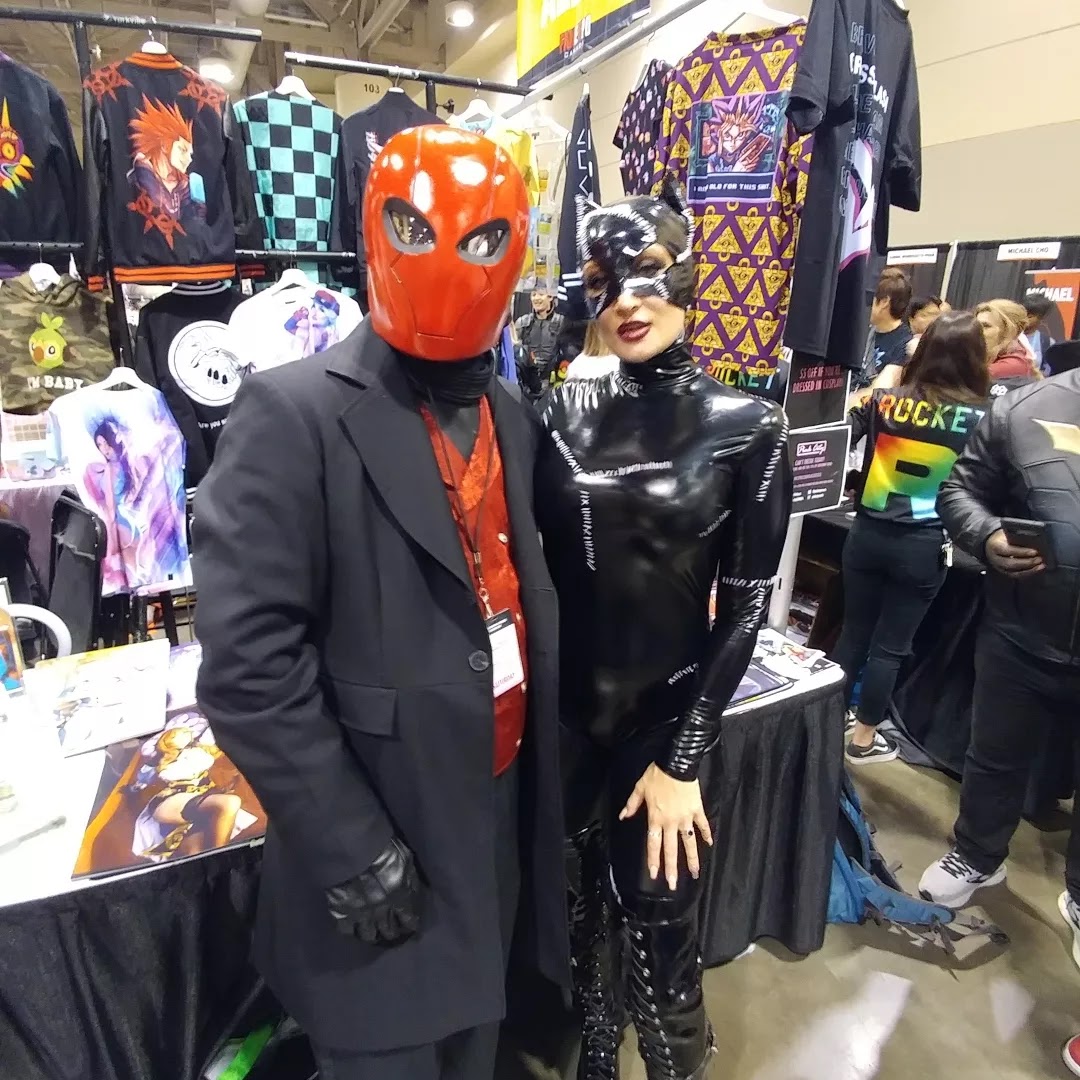
Sir Leo Worthing-Topper with cosplayer LuckyGrim, at the Toronto Fan Expo Convention.
Lord Hood with cosplayer Cassandra Ariel, at the Toronto Fan Expo Convention.
Sir Leo Worthing-Topper with cosplayer Cassandra Ariel, at the Toronto Fan Expo Convention.
Sir Leo Worthing-Topper with cosplayer Holly Wolf, at the Toronto Fan Expo Convention.
Lord Hood with cosplayer Holly Wolf, at the Toronto Fan Expo Convention.
Friday, November 25, 2022
All Is Fair In Love and War (Part III)
The Hofburg Palace, the City of Vienna, the Austrian Empire, October 1809.
As soon as Napoleon left Kaiser Franz and their combined entourages, his massive, imposing automaton-construct, the Mameluke Arion suddenly appeared at his side. The partly mechanical, partly flesh construct was formed in the fashion of a heavily armoured and armed warrior of the Egyptian Mameluke Army standing some six feet tall, with an eclectic mix of Ottoman, Egyptian and Byzantine influences concerning the ornamentation of it's person and the gear it carried. Napoleon had picked Arion up as a most unusual personal memento, during his Egyptian campaigning. A peculiar happenstance, which Napoleon felt that he would never have cause to regret. Arion, who had first been activated as a bodyguard automaton-construct in the dying days of the Roman Empire, and had served the Empire of East Rome, and it's successors the Byzantine Empire and the Ottoman Empire, and finally the Egyptian Mamelukes with a quiet competence and uncomplaining diligence. Arion's then current master, a Mameluke general, had been killed in battle by the French in one of the earlier battles of the Napoleon's campaign against the Mamelukes, and Arion, for the first time in his existence, finding himself without purpose or without a designated inheritor for his service, immediately offered his skills and personal allegiance to Napoleon, when he encountered him.
Napoleon for own part, had found Arion, indispensable as an accomplished aide-de-camp or orderly, a discrete confident and as a watchful and completely and professionally paranoid personal guardian and kept him close by both in peace and war ever since. He existed solely to guard Napoleon's person, and serve him in any capacity or task that suited his master. Arion had no agenda, nor did he venture his opinions unnecessarily although if asked a question, he would answer in a manner that was polite, yet forthright and studied. Nor did Arion flatter or shy away from uncomfortable truths when he answered, for he was always pertinent and candid in his words and meaning. Napoleon, for his part found, Arion's company soothing, productive and most reassuring which of course intensely annoyed some members of his personal entourage, his general headquarters and even his own Imperial Guard, who felt slighted by the favour Napoleon showed the strange artificial being. Neither Napoleon, nor Arion cared in the slightest about such petty jealousies. Ironically, the one unit in the Garde Impériale that did not care and in fact welcomed Arion's continued presence, was the 1st Regiment of the Chasseurs à cheval, which formed Napoleon's personal escort and body-guard on and off the battlefield. They took their protective duties as Napoleon's senior corps of elite life-guards very seriously, and were relieved and pleased that Napoleon always had someone beside him that did not tire, did not falter and would never desert him no matter the circumstances.
Marie Luise, heard Arion's distinctive metallic tread with which she was well acquainted from her time as a prisoner of Napoleon's in Graz, behind her and know instantly that Emperor Napoleon, would be with him. Arion always made a point of never being further then arm's length of his master, especially in any sort of crowd.
"Fürstin von Eggenberg." Napoleon said pleasantly, from behind her. Weiss, Blankenberg and Archduke Johann, grouped in a half circle around Marie Luise, turned to gaze at him and his bodyguard, their flow of conversation, slowed to a sudden stop. She turned slowly on her heel only after, Napoleon called her by her title seemingly refusing to acknowledge his presence until he actually spoke. Marie Luise's stance was anything put submissive, she took an unexpected pace forward on one foot, so that her legs were set slightly apart, one before the other rather like the stance one took before taking part in a duel with saber or épée. Her hips were canted slightly back, while her chest she thrust forward ever so slightly but definitely, which caused her uniform to go taunt over her breasts causing their curves to be sharply accented. Her hands, she clasped quietly behind her back, which just served to draw attention to the delicate curve of her waist and hips. Some onlookers would have considered her sudden stance surprisingly passive, others would have called it rather aggressive if they looked at it more closely. What it was, was deliberately provocative. Napoleon's only response was to raise one eyebrow, fractionally in an unspoken form of sardonic inquiry and the ghost of an amused smile briefly touched his lips and his eyes.
Marie Luise, watched his expression, and particularly his eyes silently but carefully, her beautiful blond head cocked just slightly to one side, her expression quizzical as she looked on. Napoleon, surreptitiously looked Marie Luise, up and down, liking what he saw. As always she was beautiful, meeting her again in person Napoleon would actually say she was absolutely enchanting. He admired the careful skill and hard work of her tailors and her maids, they had done her justice. He noted her exquisite, tastefully chosen jewelry, her clever use of understated make-up to enhance her own very natural beauty, her various medals and decorations. Many he had of course seen before but he made careful note of the new additions.
The four so-called 'cannon' crosses, because they were struck from bronze taken from captured french cannon, marked her participation in no less then four of the Wars of the Coalitions: in her case, the 1st, 2nd, 3rd and 5th each with an ornate, dated bar which denoted Austria's periods of participation fixed to their triangular folded black-yellow-black vertically stripped ribbons. The Medals for the Defenders of Styria and Lower Austria, and the Styrian and Lower Austrian War Merit Crosses, were also new additions, Both the defender medals, had ribbons in the colours of their respective crown lands, green and white, for Styria, and dark blue and yellow for Lower Austria, the medal itself was decorated with the crown lands particular coat-of-arms and an encircling garland of laurel leaves. The War Merit Crosses, had similar ribbons, but instead of the bronze gilt medallion of the former, they featured a metal cross, enameled black, with the enameled coat-of-arms of their respective crown lands mounted on the center medallion of the cross.
The historic and ancient military or knightly Teutonic Order (founded in 1190, which had both Catholic and Protestant branches), the Sovereign Military Hospitaller Order of Saint John of Jerusalem, of Rhodes and of Malta (founded in 1099), the Chivalric Order of Saint John of the Hospital at Jerusalem also known as the Johanniter Order or Knights Hospitaller (established also in 1099, and which had Austrian, Bohemian, Brandenburg and Dutch branches) and the Equestrian, Secular and Chapterial Order of Saint Joachim which had been founded in 1755 in the German Duchy of Saxe-Coburg, splendidly decorated her white coat.
As did the medals and decorations of the Electorate of Hessen-Kassel (the Order of Military Merit and the Iron Helm), of the Grand Duchy of Brunswick (the House Order of Henry the Lion, and the Royal Guelphic Order which was shared with the Electorate of Hannover [later part of the Kingdom of Prussia following it's sale by King George III], the Grand Duchy of Brunswick and the Kingdom of Great Britain), the Grand Duchy of Parma (the Sacred Military Constintinian Order of Saint George), the Grand Duchy of Modena (the Order of the Eagle of Este), the Grand Duchy of Tuscany (the Orders of Saint Stephen and of Saint Joseph), the Kingdom of the Two Sicilies (the Royal Order of Saint Januarius, the Sacred Military Constintinian Order of Saint George which was shared extremely grudgingly with the Grand Duchy of Parma, Napoleon noted with some amusement, and the Order of Saint Ferdinand and Merit), the Kingdom of Sardinia (the Order of Saints Maurice and Lazarus) as well as the exiled and now scattered French Royal House of Bourbon (the Royal and Military Order of Saint Louis, and the Order of Military Merit: originally an award solely for foreign protestants serving with the French Royal Army, but later expanded to cover foreign soldiers both Catholic and Protestant fighting alongside the émigré Bourbon pretenders to the throne of France and their exiled aristocratic allies as well as those directly in their service). The sight of these on someone else's person would have ordinarily seriously annoyed him, as they all belonged to ancient dynasties he had displaced or all but destroyed over the years and consequently, they could be counted amoung his bitterest enemies. Instead he recognized them for what they were: the tangible marks of the high regard and military esteem she was held in, and that she was not lacking in influential or important patrons. Not a minor consideration given Marie Luise's own and long uneasy relationship with her own sovereign.
The Austrian Military Order of Maria Theresia, The Royal Hungarian Order of St Stephen and the Imperial Order of Leopold all naturally had pride of place upon her person. As did the Order of the Raven, her family's own princely house order founded in 1647, which she wore as a matter of course. She was after all it's grand mistress and proprietor since her father's death.
Marie Luise also wore the decoration unique to every regiment or independent battalion in the Imperial-Royal Army of Austria. In her case, the unit crosses which were worn directly attached to the coat or tunic like the star of an order, were those of the Line Infantry Regiments, No.27 'Graf Strassoldo' now titled Regiment 'Chastler', Line Infantry Regiment No.4 'Hoch-und-Deutschmeister' in which she held a much prized à la suitecommission, and No.45 'Freiherr De Vaux', now Regiment 'Fürstin von Eggenberg' of which she was now Oberst-Inhaber or colonel-proprietor as the Austrians called it, or Colonel-en-chef (colonel-in-chief) as the French Armée Impériale would term the same special and highly prized appointment.
As a common soldier and non-commissioned officer she had won the Austrian Gold, Silver, Iron and Bronze Decorations of Honour for Bravery. In effect the soldiers equivalent of the Military Order Of Maria Theresia. She also wore the similar Civil Medals of Honour, as well as the Emperor Joseph II military medal which was solely awarded to soldiers regardless of their social status or rank for the highest valour, often being wounded in the process. It could also be awarded to those who had carried out their military duties in a thoroughly competent or exemplary fashion such as company, battalion and regimental commanders, as well as generals commanding brigades, divisions, corps or armies or naval officers commanding individual ships, squadrons or fleets. Marie Luise had unusually won this highly prized though sparingly given award, an unheard of four times, once as a common fusilier, as an non-commissioned officer, and again as a commissioned officer and as a general officer!
"Emperor Napoleon." Marie Luise, mimicked him in tone and brevity of words, before bowing with studied politeness and formality. If she had been wearing one of the low cut civilian dresses now in fashion, the depth of her bow, would have given Napoleon an eye full of Marie Luise's quite comely décolletage. Her tightly buttoned uniform closed up to her neck however prevented that. This not so subtle but teasing hint, actually amused and excited Napoleon. He knew what Marie Luise looked like gloriously naked well enough, and was certainly not adverse to it. In point of fact he hungered for the chance to do so again.
Marie Luise, fluidly made introductions for her party of companions, Napoleon know most of them by name if not by prior acquaintance already, but Marie Luise was careful to follow established custom and protocols for such social events. She would give her own Emperor no unjustified cause for criticism of her conduct, Napoleon noted carefully. Napoleon acknowledged each introduction, in a polite, diplomatic manner even exchanging a friendly, bantering remark with each of them.
Napoleon who had heard parts of their previous exchanges on a wide range of subjects, as he had approached them, immediately reignited the conversation by added some comments on his own experiences in Egypt, on the peculiarities of the region's weather and climate, the interesting topography and particularly of the fascinating new study of Egyptology, the ancient pharaohs, the pyramids and the mix of cultures and religions that had created them which still gripped much of intellectual Europe today despite the fact that the French Egyptian campaign of 1798 had ultimately ended somewhat ingloriously if not disastrously in 1801, with the final retreat of the French forces from the region. They all relaxed a little and soon the conversation resumed it's former animation and interest, as remarks and ideas about that ancient world, it's culture, it's languages, literature and it's marvels of engineering and architecture were freely exchanged.
Archduke Johann, remarked after some several long minutes of pleasant and vigourous discussion that he as one of the hosts of the evening, he should be circulating as it would do someone a positive social if not a physical injury, if his or Emperor Napoleon or the Fürstin von Eggenberg's attention was too long claimed by stimulating conversation, rather then the dull politics and vicious court gossip at the moment currently in vogue. Weiss and Blankenberg immediately took the subtle hint, and also took their leave of Marie Luise and Emperor Napoleon's company, leaving the two of them completely alone for the first time this evening.
Napoleon immediately turned to Marie Luise, once the others were safely out of earshot.
"Could I talk to you Mademoiselle, in private."
Marie Luise, considered him and his question for a moment in silence then nodded coolly but politely, gesturing with her one good hand for Napoleon to accompany her, as she knew the Hofburg and it's intricate and elaborate halls, rooms, galleries and passages, rather better then he did. Arion, regarded both his master, Napoleon and the Fürstin von Eggenberg, intensely with his amber yellow eyes, which glowed deep within the visor sockets of his helmeted head as he fell into step behind them. The Emperor was playing with more then just ordinary fire with this woman, not only could he wind up being rather badly burned physically if not emotionally but the overly confident hunter could quickly turn into the hunted themselves if they were not too careful.
In point of fact, Arion, was actually rather inclined to like Marie Luise, far more then he was with regards some of Napoleon's other choices of mistresses or his choice of wife for that matter. He liked anyone who gave a damn, as a matter of general principal. Arion actually found Marie Luise quite as fascinating as his master, she had deep lights, greys and shadows that few people had ever explored much less discovered. Her remarks about her own long, close friendship with the strange automaton-construct, Eisen from her native Styria had deeply interested him, because the two of them were so alike, although it was clear to Arion, that the mysterious Eisen was actually the older of the two of them. If Napoleon's relationship continued to prosper with Marie Luise, Arion looked forward to finding out a bit more about the Old Eisen and perhaps one day meeting him.
Archduke Johann, walked over to join his brother, Archduke Karl, who stood completely alone and largely out of earshot of anyone in a mercifully quiet corner away from many of the people gathered in the great hall. Karl stood silently wrapped in his own thoughts, seemingly brooding over a drink. Johann had noticed their brother Archduke Ludwig, a serving feldmarschalleutnant as well as their older brother Franz's eyes and ears within the army and the Imperial Court where he was a well established figure and blindly loyal stalwart of Kaiser Franz's, and Karl's chief-of-staff Generalmajor Maximilian Alexander Freiherr von Wimpffen had been in deep and serious conversation with Karl for some minutes, before Johann moved to join him. This probably half explained Karl's current dark mood.
Both of them, followed Napoleon's path alongside Marie Luise to one of the outer galleries of the Hofburg. Karl moodily took a long draught on his nearly full drink, but appeared to neither notice what he was drinking or to enjoy it much in any event. Johann, pursed his lips meditatively, then ventured a remark as they watched the two pass through the archway into the privacy of the gallery, trailed by Napoleon's frightening Mameluke body-guard.
"A florin for your thoughts, Karl?"
Karl, said absolutely nothing, and refused to be drawn into conversation by this opening gambit. So Johann, tried another tack, this one a lot less whimsical and certainly a lot less subtle or polite.
"It is as much your own fault, Karl. If you had done better in the battles of this blasted war, Hell if I had done a bit better in my own battles, Marie Luise would not have to resort to what she is contemplating." Johann's softly spoken words, so only Karl could hear him, had all the subtly of a sharp knife suddenly delivered unexpectedly to the underside of someone's ribs. Marie Luise had not bothered to explain her plans in great detail with Karl and Johann, only that she was going to do something to try and bend Napoleon's will in Austria's favour by any means at her disposal. Both were intelligent enough and worldly enough and knew Marie Luise quite well enough to figure out what she was thinking: without it being openly explained to either of them. Neither of them had liked it, but Marie Luise had not asked them, especially Karl for permission, she had told them solely so if they saw a political or military opening created by her appear either in private or in diplomatic negotiations with Napoleon, they would know to take advantage of it or direct Kaiser Franz's cabinet ministers and secretaries of state to do so.
Karl, snapped his grey eyed gaze upon his impertinent younger brother. The distinct note of reproach, as much as the sharp note of biting sarcasm in his brother Johann's voice had roused him from his own glum thoughts. Not that he entirely disagreed with Johann, if he and the Haupt-armee had done better, things might not have come to their current pass. Hell if he had been able to steer his stubborn, imperious brother Franz and his war hawk ministers -- all of them besotted with Britain's promised financial subsidies and their own delusions of grandeur -- and their sycophantic courtiers clear of even getting involved in another war with France, before Austria was actually ready to even attempt such a thing on it's own much less without the effective support of it's potential allies Prussia and Russia. Or if Franz, the Imperial Court and the Hofkriegsrat had let him concentrate the Haupt-armee in Bohemia as he and his general staff had originally wanted, behind the mountain passes instead of directly on the Danube, he would have been in a position to have quickly smashed the Saxon Army and over run Saxony itself, which would have cleared his northern and then allowed him to go after Bavaria on both sides of the Danube without hindrance. This would have galvanized the Prussian and Russian war hawks and made it possible for both of them to actually move against Poland or alternatively join him in Bohemia, this would have made the independent attacks made by the Kur-Hessian Legion and the Brunswick Corps into Westphalia all the more effective alongside the rebel Prussian cavalry Major Ferdinand von Schill's independent North German rebellion.
Britain's practical military aid, which Franz had had such high and quite unrealistic hopes for, during the war had amounted to little in what had been essentially an European continental conflict. Other then a thoroughly bungled attempt to invade Holland, which had been effectively contained by purely local French or Dutch units without materially effecting the balance of the armies engaged in the main theaters of war in northeastern Italy, southern and eastern Bavaria, Westphalia and in Austria itself.
Karl closed his eyes in pained self-reflection and not a little bitter self-recrimination, at the way things had actually progressed despite his best efforts. There are times he thought, when I should have just handed in my resignation when I had the chance, let the consequences be damned! His strong sense of duty to his country, his dynasty and his army had prevented that of course. They needed him, there was no one else in Austria to take his place, as generalissimus, after all. All three, now needed him now more then ever to help them to recoup, to rebuild and to retrain and save whatever could be saved out of the wreck and smoldering embers of this latest infernal and unsuccessful war with Napoleon Bonaparte. Johann watched the silent play of emotions across, Karl's face, said nothing.
"You are saying I owe, Marie Luise a heart felt apology, when this is over, Johann." Said Karl finally after regarding his brother for some moments in utter silence.
"Yes." Johann, remarked flatly.
"Any suggestions, where I start..." Karl asked with a trace of something like dry humour in his still serious and grieved expression.
"Two dozen red roses, and a box of the most expensive and delicious chocolates you can buy every day, for the rest of her life." Johann said promptly and without ceremony.
"That would not even count as a down payment, Johann." Karl said with a snort of derision.
"True." Johann, said reflectively, then a twinkle of his all too usual mischief sparkled in his own grey eyes. Which immediately put Karl on his guard, as he knew his younger brother, all too well. Johann, was up to something.
"A wedding ring, though would count, Karl." Johann, remarked with studied and remarkable verbal blandness, which did nothing to banish the mischievous devilry that glittered in his grey eyes. Karl who was in the middle of a second long draught from his wine glass, immediately started sputtering, as Johann non sequitur caught Karl completely off guard.
Marie Luise, quickly, lead Napoleon and Arion, to a side gallery which features a deep nook or recess set into a colonnaded wall. Anyone within the nook was not visible to anyone passing through the gallery's passage way. Arion immediately stationed himself in a position that allowed him to guard their privacy, but also to observe and intercept anyone entering or leaving the gallery.
Marie Luise, turned and looked at Napoleon with an expression of inquiry. Napoleon considered for several minutes how to handle what he wanted to say, and the best way to say it. After several moments, Napoleon decided that a certain degree of honesty was his best policy.
"I confess, I wanted your company solely for myself, tonight."
"You would not be the first." Marie Luise, remarked tartly. "Or, the last."
That did not surprise, Napoleon on reflection. It was highly unlikely there was any man or woman for that matter, present in the Hofburg who did not find Marie Luise highly desirable for any number of reasons, at any time.
"I have a proposition I would like to put to you. Several actually, if you would entertain to hear them."
Marie Luise, looked at Napoleon appraisingly for several long moments. Her face was absolutely still, giving nothing away. Napoleon found himself suddenly envying her detached focus and coolness. She would make an very accomplished card player at any high stakes gambling table or diplomat at any critical conference, he thought. Then, she nodded ever so slightly, one hand raised, her fingers extended palm uppermost towards him, as if to say, go on.
Napoleon put his hands behind his back, took a deep breath and collected his thoughts carefully. This was going to require some skill and tact on his part.
"Would you be interested in a command within the Grande Armée? specifically with the troops of the Confederation of the Rhine?" Napoleon finally said without flowery preamble or unnecessary ceremony. Marie Luise, raised one elegant blonde eyebrow at this fractionally, then silently considered the matter.
"A divisional command, drawn from the armies of the smaller German States, I pressume?"
"Yes, the formation would consist of regimental or battalion sized contingents from all the member states of the Confederation."
"A bit complicated to manage within the confines of a single division, even a large one, would you not agree." Marie Luise said after a few moments consideration. A divisional command would have been appropriate to offer her, Marie Luise thought, considering much of her previous military experience was at that level for several years, although her recent promotion to the rank of Feldzeugmeister or what the French called a Général de corps d'armée would normally by right of prestige, protocal and military etiquette require a higher level of assignment. This Marie Luise considered unlikely for a number of reasons.
"Oh, I agree but I was not thinking in terms of you commanding a just a single division, but rather a full corps d'armée of at least three, probably five divisions of infantry and two of cavalry along with the necessary supporting units, staffs and logistical elements."
Napoleon watched with a mixture of pleasure and not a little excitement, as both of Marie Luise's eyebrows shot upwards in response. He could well understand why, given her prior military service, a command suitable for a Général de division would not have been unreasonable thing for him to actually offer her. Particularly as his own generals and even his marshals of the Grande Armée were a prickly, contentious lot and would have been unwilling or reluctant to take orders for an outsider, let alone an Austrian general, even one of her professional accomplishments, battle hardened competence and proven bravery.
The German states of the Confederation of the Rhine, the Grand Duchies of Nassau, Kleve-Berg, Hessen-Darmstadt, Mecklenburg-Schwerin, Mecklenburg-Strelitz and Baden, the Free City states of Bremen, Hamburg, Lübeck and Frankfurt-am-Main, and the Kingdoms of Württemberg, Westphalia, Saxony, and Bavaria however would have no such difficulty, nor would there be a language barrier as German was Marie Luise's native language as it was of the German States and she was just as accomplished in the written and spoken languages of ltalian, Polish and French so adding in contingents for The Grand Duchy of Warsaw, the Kingdoms of Italy and of Naples did not present a problem or units and subordinate officers from France, for that matter. Nor was Marie Luise really a stranger to that level of command, as she had in fact organized and commanded what amounted to an ad hoc corps during the siege of Graz.
"It would be an excellent way of cementing the new alliance and relationship between France and Austria, you would agree?" Napoleon said quietly and with surprising sincerity. Although, Marie Luise did not think that was the reason for offering it, that was uppermost in his mind.
It would, and be an even more excellent way to entangle Austria still further into your own dynastic and military ambitions in the ongoing wars in Portugal and Spain. Marie Luise thought to herself. Still the proposal had merit, and could even be used in Austria's interest as well as France's. If the new relationship was carefully handled it might be used to evade, rewrite or even discard some of the more militarily damaging articles of the Second Treaty of Schönbrunn in Austria's favour. Marie Luise, was fairly certain that Kaiser Franz would refuse such a request by Napoleon to him and the Hofkriegsrat to borrow her services, point blank. She simply was not counted amoung his special favourites or those who at least enjoyed his favour, rather she was counted amoug his most passionately hated enemies. As Marie Luise, had realized her actions both in the past and especially during the Siege of Graz, had especially embarrassed her sovereign, personally or politically. It was highly unlikely she would receive any important military assignments hereafter, even baring another war, of course.
Marie Luise had privately decided after the peace had been signed to retire to her estates and take time to recuperate, devote herself anew to her family's businesses, enterprises and various properties and lands and their inhabitants. The idea of hurling herself into harms way in yet another war, half a continent away for a master and a cause that was not her own and one that she did not in the least sympathize with was distasteful in the extreme.
"His Majesty, would likely refuse such an idea." Marie Luise said aloud. Napoleon nodded he had been thinking much the same thing.
"He, might be persuaded." Napoleon responded cryptically.
"That would be a neat trick if you could pull it off. Habsburgs are not easily persuaded into or out of anything." Marie Luise smile was touched with sardonic humour and just a hint of sarcasm. Marie Luise had made the acquaintance, one rather more intimately then others, of several Habsburgs ranging from the emperor to the various archdukes and archduchesses, and they were all of them: good, bad or indifferent as they might be as human beings, they were to a man or woman willful, imperiously proud and stubborn past the point of mere obstinance!
"Very true." Napoleon observed equally laconically. "Still there is no harm in my asking him, with your permission of course?"
Marie Luise, responded with another silent almost imperceptible nod. Napoleon visibly relaxed a bit, he had obviously been prepared for a blunt refusal on her part. Marie Luise, noted this, then decided to verify, a suspicion that had been long in her mind about Napoleon's intentions towards her.
"If your offer of a military command, fails to get me to Paris and the Tuileries, what then, Your Majesty?" Marie Luise asked quietly, her head tilted slightly sideways, as she looked at him once again with an appraising glance. There was something teasing, even inviting in the tilt of her head and the poise of her attractively full lipped, mouth. Her large, spectacularly jewel like green eyes sparkled alluringly at him
"I would request, that Kaiser Franz send you as a special envoy, to assist in working out the remaining military details of the peace treaty and such other negotiations that might concern both our countries in due course. I do not imagine that he would object to that request quite so strongly, in fact he might, I think welcome it." Napoleon said flatly, almost without thinking or realising what he had just been quietly trapped into saying aloud.
"He, might at that". Marie Luise, said aloud, although what she thought to herself was rather another matter. Karl would object to it, and I even understand why, and his reasons would have nothing to do with Austria losing my military services. Karl, would be desperately worried that he was losing... me.
"So what you really want.... is." Marie Luise, remarked candidly. "Me." She suddenly took a step forward and Napoleon found himself with Marie Luise so close to him, that her breasts brushed the front of his own green, red piped Chasseurs à cheval tunic. Napoleon felt his face uncontrollably heat, with desire for her, she noticed it, just as much as he did. Her pale yellow gloved hands suddenly came up, and clamped firmly around both his face and neck. With a strength that both surprised and alarmed him, she pulled him forward and towards her. Marie Luise's sweet mouth swiftly closed over his.