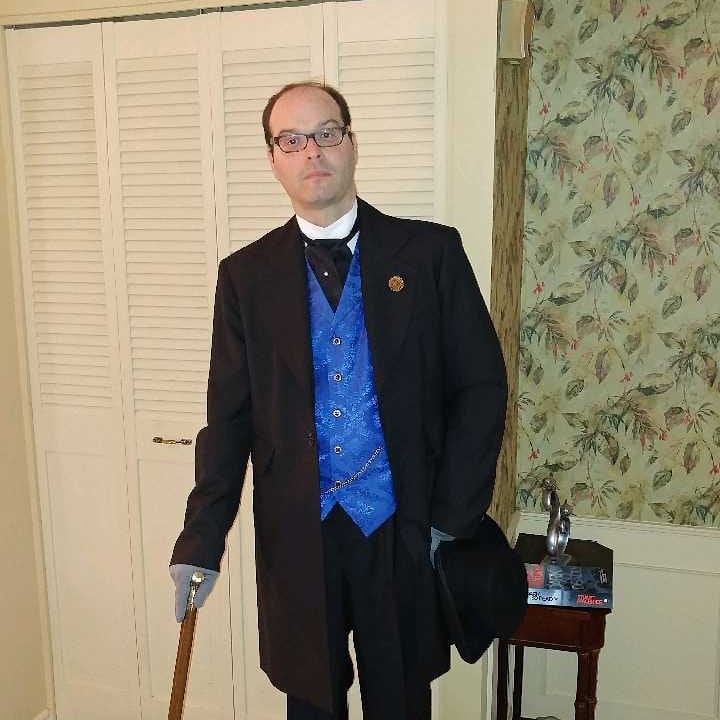
Welcome Lords, Ladies and Gentlemen.


Welcome Lords, Ladies and Gentlefolk.

This blog will be devoted to my literary and cosplay interests and stories set in my own alternative historical steampunk background. I hope people enjoy the stories, as much as I enjoy devising and writing them and that it stimulates their own artistic interests, entertains them or if nothing else fires their own imaginations.

A special note to new readers of this blog, the entries "Nation States" are gazetteers of the nations as they exist in the An Age of Steam, Steel and Iron background, each with a few remarks/observations about each nation as they exist within. Any post headed by the title containing the words "Story Snippet" or "Fragments" is a stand alone, snapshot of the background, they will be developed into fuller stories in future, but at present they serve to give the viewer/reader a measure of what this world is like, what is going on in it and who some of the players are. Full stories, will be headed by their title and a roman number, as they will generally be in several parts.

Comments, suggestions or remarks by readers are welcomed.

I would like to thank the following people:

Yaya Han, for getting me seriously interested in cosplay at a time when things were looking very glum for me back in 2006 with several extended stays in hospital due to illness, and motivating me to get actively involved.

Ashley Du aka UndeadDu, for her unfailing friendship and cheerful support since we first met in 2014 at the Hamilton Comic Con, and for being my Cosplay mentor and advisor.

Sara Marly, for her interest in and support for my writings, since we first met in 2016 at the Hamilton Comic Con and incidently helping me make up my mind to finally do this.

Stephen Thomson, my friend, for his advise and assistance with creating and setting up this blog.

Daniel Cote, my friend and co-worker for his advise and friendship over the years.

The People of the The Aegy's Gathering (particularly Jonathan Cresswell-Jones, Scott Washburn and Jenny Dolfen, all of whom I have kept in contact with over the years), who were brought together in friendship by a certain randomness of chance and a common interest in the Honor Harrington books and stayed together despite distance and the strains of life.


The People of the Wesworld Alternative History website, who gave me the opportunity to sharpen my writing and story telling skills while directing the affairs of Lithuania and briefly France during their 1930s timelines.

My parents Mary Ellen (1946 - 2019) and Logan, my siblings Adam and Danika and various friends both online and at work and play for putting up with me, encouraging and supporting me both in the very good times and the very bad times.

I remain as always yours very sincerely, your obedient servant, Matthew Baird aka Sir Leopold Stanley Worthing-Topper


Wednesday, June 23, 2021

Some Thoughts on the Development of Airpower in A.A.S.S.I.

Heavier-then-air aircraft i.e. aircraft or airplanes are a fairly recent innovation in the A.A.S.S.I. background although the principles of flight have been well understood since Antiquity. Innovation in aircraft design lead to the development of lighter-then-air travel becoming widespread before the 19th century, via the medium of hot air balloons and those using later lifting gas of superior performance such as hydrogen and helium gas.

Further experimentation lead to the development of blimps, semi-rigid and rigid dirigibles or airships. Attempts to develop steam powered aircraft however were something of a dead end as the particularities of steam engines fire boxes and boilers do not lend themselves to air travel, although air plane designs powered by steam ball/accumulators did enjoy some success as they dispensed with furnaces and boilers altogether, but often these designs lacked extended endurance in flight and were subject to varied power plant performances at different altitudes and atmospheric pressures. Both early observation balloons, early airships and aircraft played a innovative although often mixed part in land and sea warfare through several wars including the Napoleonic Era and later wars such as the Crimean War and the American Civil War, as did the fast emerging sky ship technologies.

As if the 1880s, air power of all three types: airplanes, dirigibles/airships and sky ships, are integrated into the various countries militaries, although no one as yet has all three weapons systems in an separate national air force, most aircraft or airships are part of either a given army or navy's branches, while sky ships still tend to be the preserve of most navies, except in one of two rare cased of land locked countries, which have no regular naval forces save perhaps riverine forces.

Wednesday, April 14, 2021

A New Beginning on the Gulf of Tadjoura

January 6, 1889, Sagallo, the Gulf of Tadjoura, French Somilialand.
Flag of New Moscow (Sagallo).
The Fort and Colony of Sagallo
Nikolay Ivanovitch Achinov, Governor of the Free Cossack Colony of New Moscow (Sagallo) and Hetman of the Tadjoura Cossack Host.

The trio of steam ships anchored without fuss or fanfare in the placid waters of the Gulf of Tadjoura, off shore of the coastal village of Sagallo. Two of the ships were Russian registered, SS Kornilov and SS Lazarev, while the third SS Amfitrida ((Austrian Lloyd, built 1884, 3,839 grt) was of Austro-Hungarian registry. The captain of the Amfitrida, which was acting as the convoy's flagship watched as the first boats and launches moved towards the shore to land and take possession of Sagallo, little more then a miserable collection of hovels as one of his officers had remarked when they had first arrived.

Sagallo had in the centuries past been an important meeting point for the trade caravans travelling throughout the Horn of Africa region and beyond. Local dhows, trading thoughout the Gulf of Tadjoura and Red Sea, had and still did use the village as a transfer, watering and vitualing port. The Gulf itself offered much in the way of trade and resourse possibilies: timber from the coastal mangroves, Pearls and fish from the local fisheries and fishing grounds, as well as coral from the numerous reefs and salt from the coastal salt pans and marshes. All that was required was investment capital, organization and people.

The Ottoman Empire had come to rule much of the area around the 16th century and had built a fort, barracks and outposts to secure and patrol the area around Sagallo. However the Ottomans had slowly begun a steady withdrawal of their interest and their administration and troops even before Italy, Great Britain, Abyassinia and France had begun to stake claims in the Eritea and the Somilialands. The outcomes of the 2nd Anglo-Ottoman War had put paid to any further interest that the Ottoman Empire had in the region, and their withdrawal had accelerated with indecent hast. In the end, the last of their outposts, camps, forts and barracks in the region had been left to rot or be taken over by the native Somali or Afar tribesmen.

The Russian Empire while greatly interested in affairs nearer to home in Central Asia, East Asia and the Balkans, had been encouraged to take an interest in colonizing efforts outside Europe and Eurasia. From what the captain understood from talking to the officers of the Russian expedition. So out to these scortched lands by the sea, had come some one hundred and sixty-five Terek Cossacks and thirty-four civilian colonists. Their leader was a colourful, robust fellow, the captain thought. Nikolay Ivanovitch Achinov, had gone out with the first boats to claim the fort and raise the flag of his free cossack colony, over Sagallo.

Evidently Achinov had an agreement with the Sultan of Tadjoura, Mohammed Loitah, for the lease of the lands in and around Sagallo. The Austrian captain had expressed concern to Achinov at the small size of the expedition. In colonies, particularly starting ones, manpower and skills were always at a premium. Achinov had agreed and pointed out that this group was merely the first wave of colonists, more would arrive in the next few days and following weeks. In the meantime, mindful of the needs of a developing colony, the three ships had been stuffed nearly to bursting with tools, machinery, construction and building materials, camp equipment and utentials, trade goods for business with the locals and munitions.

Which thought the captain, at least put the Cossacks off to a reasonable start. Although Achinov had been confident of his relations with the natives in the area. Some of his cossack officers and his colonists had expressed reservations about how the French were likely to response, once they realized the colony had been established in territory they claimed. The captain had warned them at a council meeting just before the first boats had been sent away, that the French had invested the majority of their attention on the south coast of the Gulf, they were not likely to take notice of anything going on with regards to the Northern side of the Gulf unless it was loud and dramatic or too close for comfort to their naval station at the Port of Obock. The French had a Naval Squadron at Obock, consisting of a cruiser and three gunboats. If the French were in the mood to be belligerant then they were in the position to do something about it.

Saturday, November 28, 2020

A Question of Territorial Exchange (Part III)

Imperial and Royal Ministry of Foreign Affairs, Ballhausplatz, Vienna, Austria-Hungary, January 1889.
"In addition to the former Ifni consul-general, I am also expecting an offical from the Spanish Embassy, to explore the details of this offer." Haymerle remaked absently returning his attention to the papers on his desk.
"The Spanish are being damned secretative about the whole affair but at the same time energetic about pushing the matter with us. Probably worries about how the matter will be viewed by the parties in the Spanish Cortes." Haymerle said after some moments of quiet refection. Archduke Friedrich nodded in response before commenting himself.

"I suppose, the Spanish Embassy is anxious because of all the diplomatic thunder and lightning that was occassioned by our ongoing negotiations into obtaining a lease on Walfisch Bay from the Germans in their Southwest Africa colony. They likely expect a similar uproar from the other Great Powers with an interest in the West African situation as it currently stands. Then there is the Moroccan side of it. How will the Sultan Hassan react?"
"Hm. True, very true." Haymerle nodded and turned as his aide knocked at the door, then entered.

"Yes, Franz?"

"The former Ifni Protectorate consul-general and senior military officer has just arrived, Your Excellency do you want to see him immediately?"

"Yes, Franz, send him in immediately."

Haymerle, gave his side whiskers another absentminded but thoughtful tug, as he turned the matter over again in his mind. Compared to most of the Great Powers, Austria-Hungary's colonial possessions were fairly minor. They amounted to a handful of colonies, protectorates and trade concessions scattered around the world; just enough to give the Empire a certain amount of prestige amoungst it's peers. They were also quietly prosperous and internally peaceful enough on their own merits that they did not cost the k.u.k. government too much to protect, police or administer to. The flip side of that agreeable equilibrium was that said colonies, protectorates and concessions were sufficiently profitable and so placed that they inevitablely irked someone else in the region or found themselves being entertained in some other powers's expansionistic designs.

Haymerle, snorted to himself quietly, in thoughtful exasperation and sarcasm.

The bulk of the colonial trade concessions that the Austro-hungarian Empire possessed rested in Asia. In particular, the two trade concessions in the Chinese cities of Shanghai and Tientsin respectively. The other two Asian concessions were in India, Cabelon on the Coromandel Coast and Banquibazar on the Hooghli River, upstream from Calcutta in Bengal. These concessions were almost exclusively concerned with trade and travel and thus were largely run by the k.u.k. Consular Service, although the Ministry of the Marine and Colonies was in charge of their security and overall management. The last of the Austro-Hungarian trade concessions was located in Delagoa Bay, in Portuguese East Africa. It had been established by the Austrian East India Company in the 1776-81 period and had sufficiently annoyed the Portuguese into attempting by force to evict the trade concession from an area they considered theirs.

Their response had been to send a battalion of 500 men and a 40-gun frigate from Portuguese Goa in India to drive the Austrians enscounced at the trade fortresses of St Joseph and St Maria. The Austrian East India Company had been warned that the attempt was coming and had taken precautions including assembling a small fleet of a half dozen warships or heavily armed east indianman merchantile vessels and reinforced the fortresses with several hundred men and a hundred artillery pieces of various sizes. To the Portuguese commander's credit he did make a serious effort to carry out his orders but after being defeated by William Bolts, the Portugese authorities thought better of the effort and concentrated on other more profitable projects.

The Austro-Hungarian colonies proper could be considered to start with North Borneo in the East Indies, this area had been acquired semi-privately in the 1866, 1876 and 1879 by the Torrey-Dent-Overbeck Colonial Trade Company before becoming a formal Austrian possession in 1881. Moving westward towards Europe came the Nicobar islands, in eastern part of the India Ocean. These islands had been originally claimed by the Austrian East India Company as far back as 1778. The Austrians had stubbornly held onto them despite various attempts by both the Danish and the English to dislodge them at various times, sometimes by force. Next came the Austro-Hungarian Diu Enclave in western India, which actually included Diu island and a sizeable portion of the adjacent shore.

Friday, November 13, 2020

Pictures of my Sir Leo Stanley Worthing-Topper Cosplay 2019-2020

The First and Second Pictures were taken in 2019.
The next pictures were taken in 2020.
I've made a small number of changes over time, the extensive sideburns I now have is the latest, and helps with giving the cosplay a more period feel, as do the spectacules.

Wednesday, May 20, 2020

A Question of Territorial Exchange (Part II)

Imperial and Royal Ministry of Foreign Affairs, Ballhausplatz, Vienna, Austria-Hungary, January 1889.


 "Quite honestly, I am still surprised the Spanish government is even willing to bring the matter up. They have had to surrender or sell off so much of their colonial empire over the last two centuries, that they have shown a very stubborn resistence to parting with anything they have left." Haymerle commented once again tugging on his side whiskers thoughtfully.

"Well, consider it from their point of view, the Ifni Protectorate is surrounded on three sides by the Sultanate of Morocco. They have considerablely more valuable and extensive territories in northern Morocco, on the south side of the Straits of Gibraltar and the Spanish Sahara: the Rio de Oro as they sometimes call it, to the south of Morocco, adjacent to the Spanish Canary islands. If they feel they have to sacrifice one of their three remaining African holding to concentrate on the other two, then Ifni is the one they can afford with the least investment in it both from a national and emotional point of view." Archduke Friedrich remarked as he considered the matter carefully.

"And it would not kick up too much of a fuss for us domestically to accept the offer, although offically, the cabinet-council is not interested in further colonial adventures of any kind, we have all the trouble we need here at home or in the colonial holdings we already have." Haymerle, picked up a map of northern Africa from the clutter of papers upon his desk. "That said, I really do not know much about the place so I am not at all sure I could get the cabinet and His Majesty to accept the idea. The Spanish still have not told me exactly what they want for it, yet."


Haymerle, passed the map to the Archduke, who nodded in agreement with the foreign minister's skeptical mood. Archduke Friedrich looked at the Ifni Protectorate map critically for some minutes before commenting.

 "Well it is a north African port, which would give us a station and stop off point on the Atlantic for our Navy and our Merchant Marine for other more important ports of call. I have briefly visited the place several times over the years. As I recall it is not an terribly exciting place, it's basically an enclave centered on the fishing port of Sidi Ifni with a few hundred square kilometers of sparsely populated hinterland surrounding it. That said, it is at least a quietly prosperous and largely contented place. I have never heard the Spanish having much problem administering the place. Though the Sultans of Morocco have had their eye on the protectorate though since the Spanish first put down roots there in the 1400s if I recall correctly."

"I imagine the Sultan will not enjoy the news that someone else might take over the place."

"I imagine not, but I think we can make such a deal acceptable to the Sultan's government, if we offer them some worthwhile economic or political incentives."


Haymerle frowned thoughtfully as he considered the matter once again, then sighed and tugged on his side whiskers.

"Well, I have sent for one of the former consul-generals we had assigned to the place, to give me some first hand information about the place and how it might be valuable to us. More importantly he can tell us, just how much trouble it will cause us locally if we do accept the Spanish offer. Assuming of course, we can actually convince His Majesty and the Cabinet-Council to accept the offer."

"When do you expect him?" Archduke Friedrich asked.

"Momentarily, actually. He is a naval officer, since Sidi Ifni did not require a full diplomatic offical, just someone to look after trade and the odd visiting Austro-Hungarian citizen or business group that might have cause to be in the enclave. He also looked after such military affairs as we had and as might be necessary in the region. He came back to Vienna last year and has been attached to the foreign ministry archives. He has been helping with the ongoing updates of the information dossiers, the ministry maintains on Morocco in particular and the West African affairs in general."

Wednesday, February 19, 2020

Attendence at the Kendal Ball (Part XIII)

Kendal Palace, Grosvenor Square, London, Great Britain: January 1886.

Ursula Wraithdale, eyed the languid, swaggering approach of Lord Roderick Crossley with scant favour, although she concealed it well enough from those immediately around her. Regis Crossley, however, after a life time's service in the diplomatic and consular corps was an expert reader of body language and facial expression. He realized exactly who Ursula was looking at, and knew instantly that it meant trouble. Sir Thomas Jameson's tightly controlled non-expression would have been warning enough to Regis, as he stood silently but supportive beside the duchess.

Sir Leo, warned by the announcement of Baron Landseer's arrival, had quietly but swiftly come back to the young duchess's side with the other six Wraithdale Estate trustees following close behind. They had just gotten within earshot when Ursula finished her welcome of the Baron Landseer and turned to greet his younger brother.

At that moment, Regis, noticed the Wraithdale Trustees materialized out of the throng of guests behind the Duchess of Kendal. Sir Leo was in the lead, flanked by Lady Penelope Wraithdale and Dame Daphne Cosgrave. Regis observed Duncan Foster, Sir Samuel Thistlewood, Alistair Scattergood and Philipa Fieldhouse followed close behind them. Foster was an accomplished and hardworking solicitor with graying, light brown hair, with a quiet, studious and methodical air to him. Gold spectacles topped his strong beak like nose, which along with his balding crown and long sideburns and muttonchops lent an inquisitive, scholarly air to him.

Thistlewood, was a craggy, hard featured man, dark haired and dark eyed with a short, bristling beard, who despite his great wealth as a businessman and investor and accomplishments as a serious inventor, engineer and scientist, never quite shed his working class origins nor had he ever tried. Thistlewood was the epitome of the hard working, serious but thoughtful self-made man, though without the arrogance of some of that bred. Regis also noted Thistlewood's heavily gloved hands, which covered the replacement mechanical appendages which replaced the fingers and wrists destroyed years ago by a few technological mishaps.

Scattergood, gave the impression to the casual observer of dandified elegance. While only of average height, he had a fit build and handsome, swarthy features framed by soft mouse brown grey hair and long sideburns. His handsome face was marked with an almost permanently amused expression fixed upon it. His grey eyes however were at this moment without their customary sardonic expression, they were alert, clear and watchful.

Fieldhouse, watched the unfolding scene with a disturbing almost reptile like calm, which was hardly surprising give her family background, Regis thought wryly. Philipa's father was an English born human but her Austrian mother had been a mix of human, Lemurian and Serpentine.Which was not as obvious as one would have thought, unless you knew what to look for. The dark glasses she habitually wore had slipped down slightly, revealing just a hint of her vivid yellow eyes with vertically slit black pupils. She had a strikingly olive completion which went with a willowy, lithe figure and equally exotic and strikingly beautiful facial features which were suggestive of her unusual li
neage.

"Lord Crossley, I do not believe you have made the acquaintance of Sir Thomas, before now?" Ursula asked suddenly with a decidedly mischievious expression playing upon her face. When Roderick, languidly if politely indicated that that was indeed the case. Ursula smiled even more disarmingly and then ushering Sir Thomas a pace or two forward so that he was standing directly beside her.

"Lord Crossley, allow me to introduce you to Sir Thomas Jameson, Captain of the Locke and Key Line, my fiance."

Saturday, December 14, 2019

A Question of Territorial Exchange (Part I)

 Imperial and Royal Ministry of Foreign Affairs, Ballhausplatz, Vienna, Austria-Hungary, January 1889.


Heinrich Karl Freiherr von Haymerle, the Austro-Hungarian foreign minister looked up from the rather puzzling packet of assorted diplomatic notes, papers and private letters sent to his office that morning by the Spanish Embassy, which cluttering his desk. The ornate, gilded wood doors of his office had opened quietly, and admitted his private secretary, Franz.

"His Imperial and Royal Highness, the Erzherzog Friedrich, is here to see you, Your Excellency." Franz said with some diffidence.

A moment later, the white-haired archduke entered the room himself, an expression of mild but thoughtful bemusement on his clean shaven features. Which Haymerle could quite understand, he himself had worn the same expression this morning when he had started reading his morning's correspondence and had to request a meeting with the Imperial and Royal Minister of the Marine and Colonies. 


Archduke Friedrich Ferdinand Leopold, was something of an irregularity amoungst the members of the House of Habsburg-Lorraine, to whom army careers were very much the norm: in that he was a highly professional and enthusiastic naval officer and took to his ministerial duties with a rare combination of zeal and effectiveness and enjoyed widespread popularity and respect both amoung his governmental peers and subordinates.

At sixty-eight, he had an accomplished naval and ministerial career behind him, having served in various capacities with the k.u.k. Kriegsmarine, as ship captain, squadron and fleet commander, naval commander-in-chief and naval minister. Although now grown grey in the service of his dynasty and his country, he had joined the Austrian Navy at the age of sixteen in 1837, and been involved in every crisis or war that Austria had experienced since. Archduke Friedrich had not lost his zest for active duty, his devotion to the interests of the Navy and doing his best in whatever assignment he was given by his sovereign.

"My apologies, Your Highness, for requesting this meeting so unexpectedly, but a matter of some interest and importance has come to my attention this morning." Haymerle tugged at his side whiskers uncertainly as he rose quickly to greet his fellow cabinet minister and gestured for him to take a seat in a comfortable arm chair before the desk.

"Your letter of this morning indicated you wanted to sound me out about something before approaching the cabinet and His Majesty, perhaps with us handling the matter in joint fashion, if I considered it prudent to do so." Archduke Friedrich remarked quietly as he took the proffered seat.

"That will be all, Franz, my thanks." Haymerle, remarked to his quiet secretary, who took the cue and left the two men alone to whatever business they had to discuss, both men heard the doors lock behind them as the secretary closed them.

"Yes." Haymerle continued still looking unsure how to proceed, Archduke Friedrich realized the matter must have been both unexpected and unusual to put the normal poised and accomplished diplomat off balance.

"I will presume for the moment that the matter involves, at the moment at least, the Foreign Office and the Navy?"

"Yes, and the Spanish Government, and our own cabinet colleges, eventually." Haymerle said abruptly, as he turned and picked up a envelope from the pile upon his desk. He passed it without another word, to the archduke. Friedrich took the envelope, removed and unfolded the pages of the letter within in it and began reading. His white eyebrows rose in surprise as he read, though his eyes remained thoughtful.

"I see, why you wanted to discuss this..." Archduke Friedrich said after several long moments of careful reflection. He settled back in the arm chair, putting the letter aside on the right arm of the chair, then looked up at the foreign minister.

"The question being, what do we do about this?" Friedrich remarked thumping the letter with the fingers of his right hand for emphasis.


Notes:
1) Erzherzog, Freiherr: German for the title of Archduke and Baron, respectively.